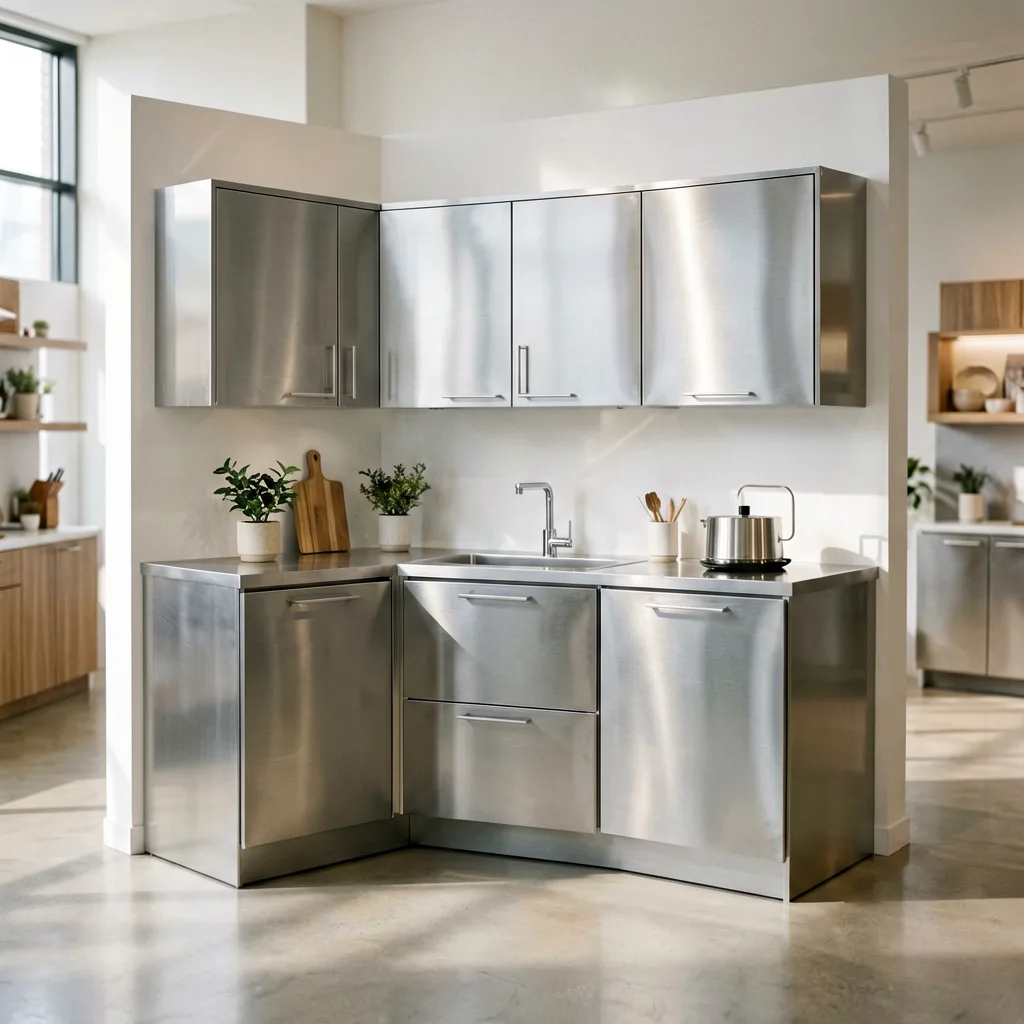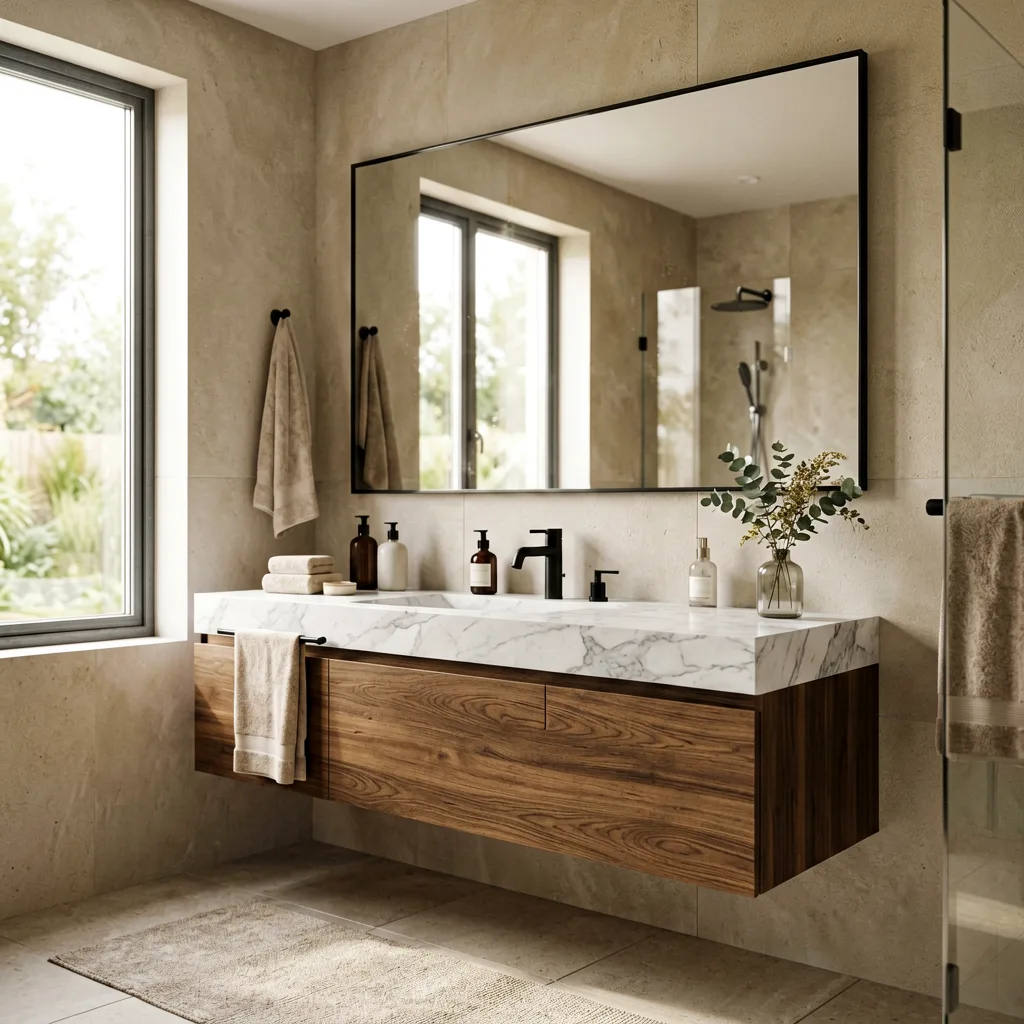
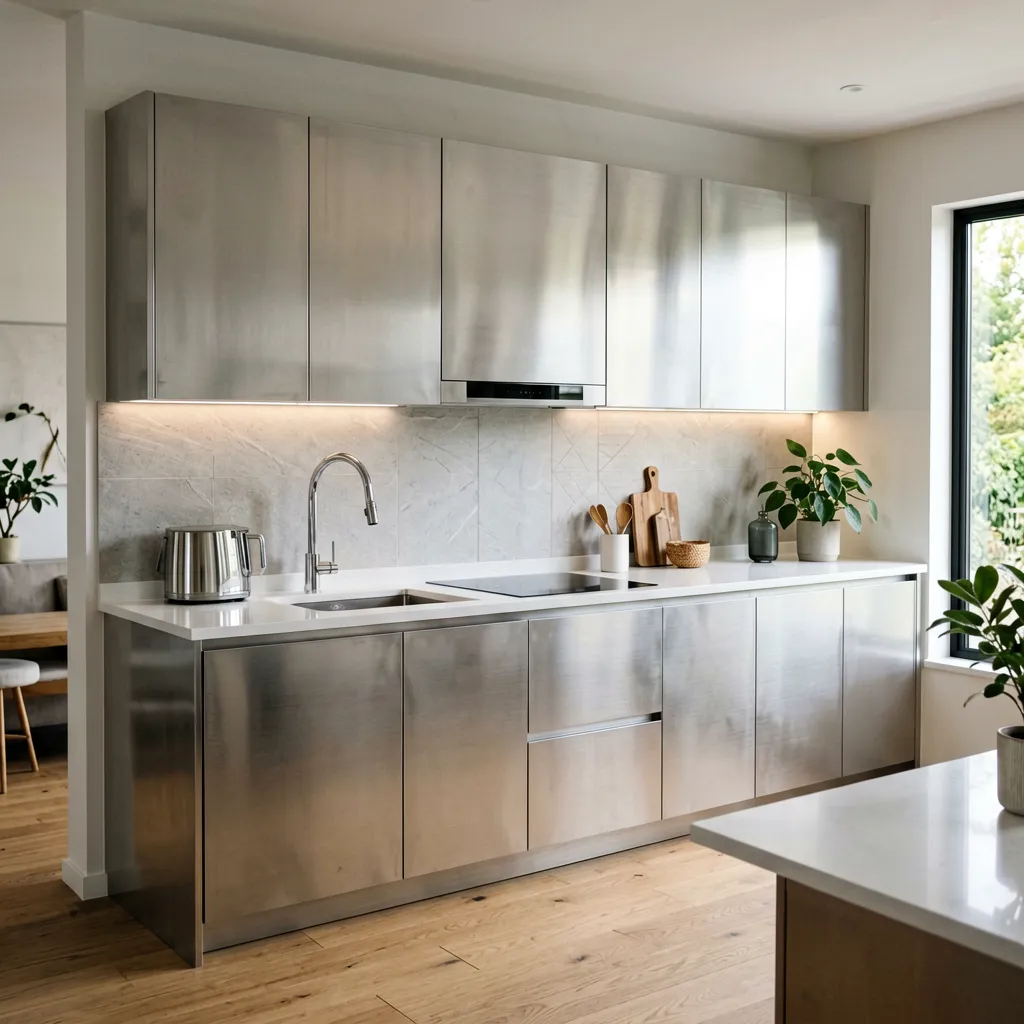
Modern aluminum kitchen cabinets bring clean lines and lasting durability to contemporary residential builds. — Image for illustration.
Kitchen cabinets are among the highest-ticket line items in any residential or commercial build. For North American contractors, developers, and wholesale buyers sourcing at scale, the material decision you make today shapes project profitability, client satisfaction, and callbacks for years to come. For 2026, one option is generating serious momentum in the trade: aluminum kitchen cabinets manufactured in China.
Why the surge in interest? Modern aluminum cabinetry solves real problems that wood and even stainless steel have struggled with in moisture-prone kitchen environments. A wholesale aluminum kitchen cabinets China supply chain — when navigated correctly — can deliver 30–45% cost savings versus North American equivalents, with customizable dimensions, finishes, and hardware that meet local building codes.
This guide covers everything you need to know before placing your first order: how aluminum cabinets compare against wood and stainless steel, the technical specifications that matter most, how to vet Chinese manufacturers, what drives pricing, quality standards and certifications to demand, and the logistics realities of transpacific freight.
Key market data: The global kitchen cabinet market was valued at approximately $167 billion in 2024 and is projected to grow at a CAGR of 6.2% through 2033 (Fortune Business Insights, 2025). Within North America, the shift toward durable, moisture-resistant cabinet materials in coastal, humid, and multi-family residential markets is accelerating demand for aluminum alternatives.
Why Aluminum Kitchen Cabinets Are Growing in Popularity (2026 Market Trends)
Three converging forces are driving aluminum cabinet adoption in North American markets in 2026.
First, moisture resilience has become a non-negotiable spec in high-humidity regions. According to the National Kitchen & Bath Association (NKBA), more than 60% of kitchen renovation callbacks relate to moisture damage — warped doors, delaminated panels, and moldy interiors (NKBA 2024 Design Trends Report). Aluminum’s structural integrity in humid environments directly addresses this pain point.
Second, green building standards are tightening material requirements. LEED v5 and CALGreen 2025 both incentivize materials with low VOC emissions, recyclability, and long service life. Aluminum is 100% recyclable, emits near-zero formaldehyde (unlike most engineered wood products), and carries a lifespan of 40+ years under normal use.
Third, supply chain diversification post-2020 has made North American buyers more sophisticated about international sourcing. China-based aluminum cabinet manufacturers have responded by improving QC protocols, offering English-language communication, and building OEM/ODM capabilities that rival domestic producers at a fraction of the cost.
Aluminum vs. Wood vs. Stainless Steel Cabinets: A Direct Comparison
Choosing the right cabinet material depends on your project profile: budget, environment, aesthetic goals, and client expectations. The table below provides a side-by-side comparison of the three most common materials in commercial and residential kitchen builds.
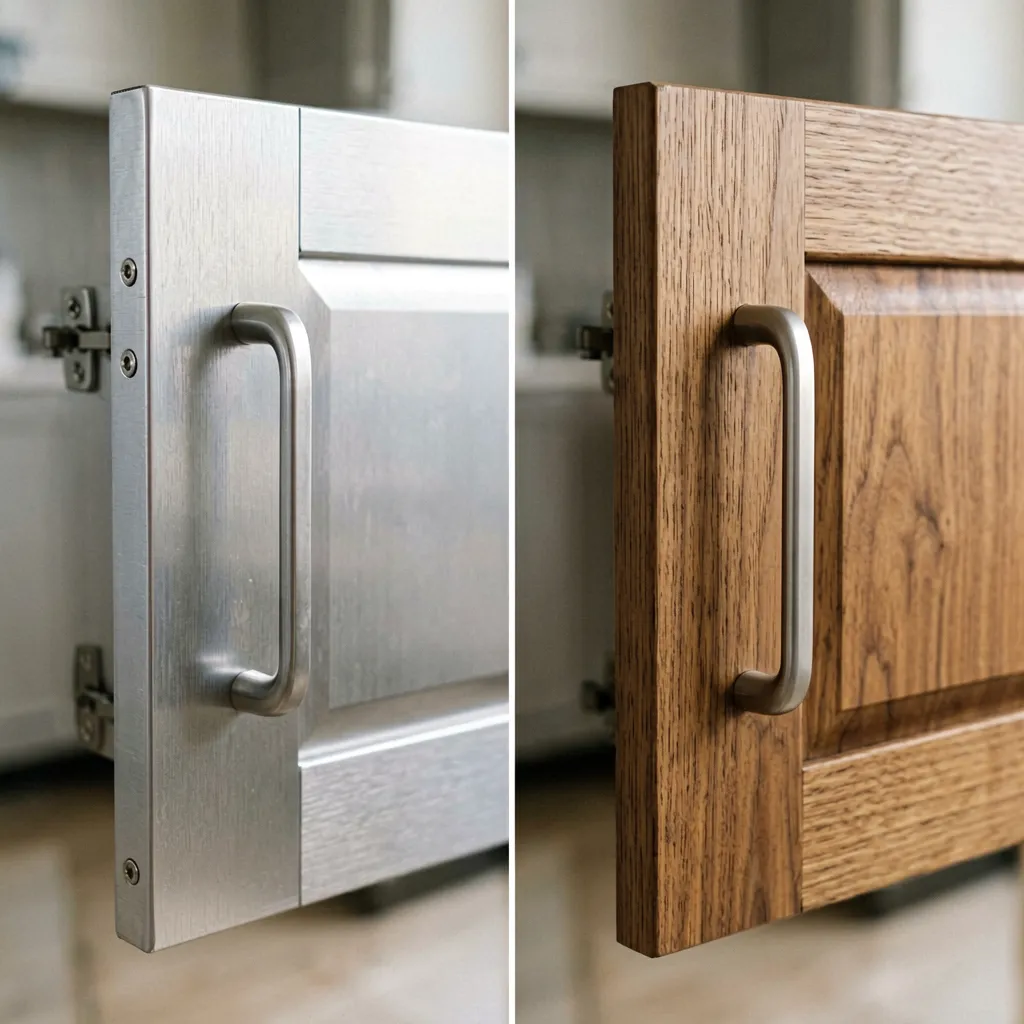
Aluminum cabinet doors (left) resist warping and moisture intrusion far more effectively than wood (right), making them ideal for humid climates and commercial kitchens.
| Malzeme | Dayanıklılık | Moisture Resistance | Ağırlık | Relative Cost (Wholesale) | Best Use Cases |
|---|---|---|---|---|---|
| Aluminum | Excellent — 40+ yr lifespan; dent-resistant; no rot | Excellent — Fully waterproof; zero swelling or delamination | Light — ~2.5–3.5 kg/m² (hollow-core honeycomb panel) | Orta — 30–45% below North American equivalents | Coastal homes, humid climates, commercial kitchens, senior living, RV/marine |
| Wood (Solid / Plywood) | İyi — 15–25 yr avg; susceptible to warping and pests | Orta — Sealed finish required; prolonged moisture causes swelling | Orta — ~8–12 kg/m² (plywood) | Moderate–High — Variable; premium hardwoods are costly | Dry-climate residential, traditional aesthetics, painted finishes |
| Stainless Steel | Excellent — 50+ yr lifespan; corrosion-resistant | Excellent — Impervious to moisture; ideal for wet environments | Heavy — ~15–20 kg/m²; requires reinforced cabinet boxes | High — 2–3× the cost of aluminum cabinet equivalents | Commercial kitchens, medical facilities, industrial settings, luxury homes |
For most North American wholesale buyers — particularly those serving coastal, high-humidity, or multi-family residential markets — aluminum kitchen cabinets from China offer the strongest value proposition. They deliver near-stainless performance in terms of moisture resistance while costing significantly less and weighing far less, which reduces shipping costs and structural load.
Key Specifications to Know Before Buying Aluminum Kitchen Cabinets
Aluminum cabinet quality varies considerably between manufacturers. Before requesting quotes or placing orders, familiarize yourself with these core specifications.
Panel Construction
Most modern aluminum kitchen cabinets use one of two panel constructions:
- Hollow-core aluminum panels: Extruded aluminum frames with aluminum sheet skins. Lightweight but may have less sound-dampening. Common in RVs, marine, and budget-conscious projects.
- Aluminum honeycomb panels: Aluminum skins bonded to a hexagonal aluminum honeycomb core. Significantly more rigid, better sound insulation, and superior flatness over large spans. Preferred for high-end residential and commercial applications. Most Chinese manufacturers capable of producing quality honeycomb panels operate at ISO 9001-certified facilities.
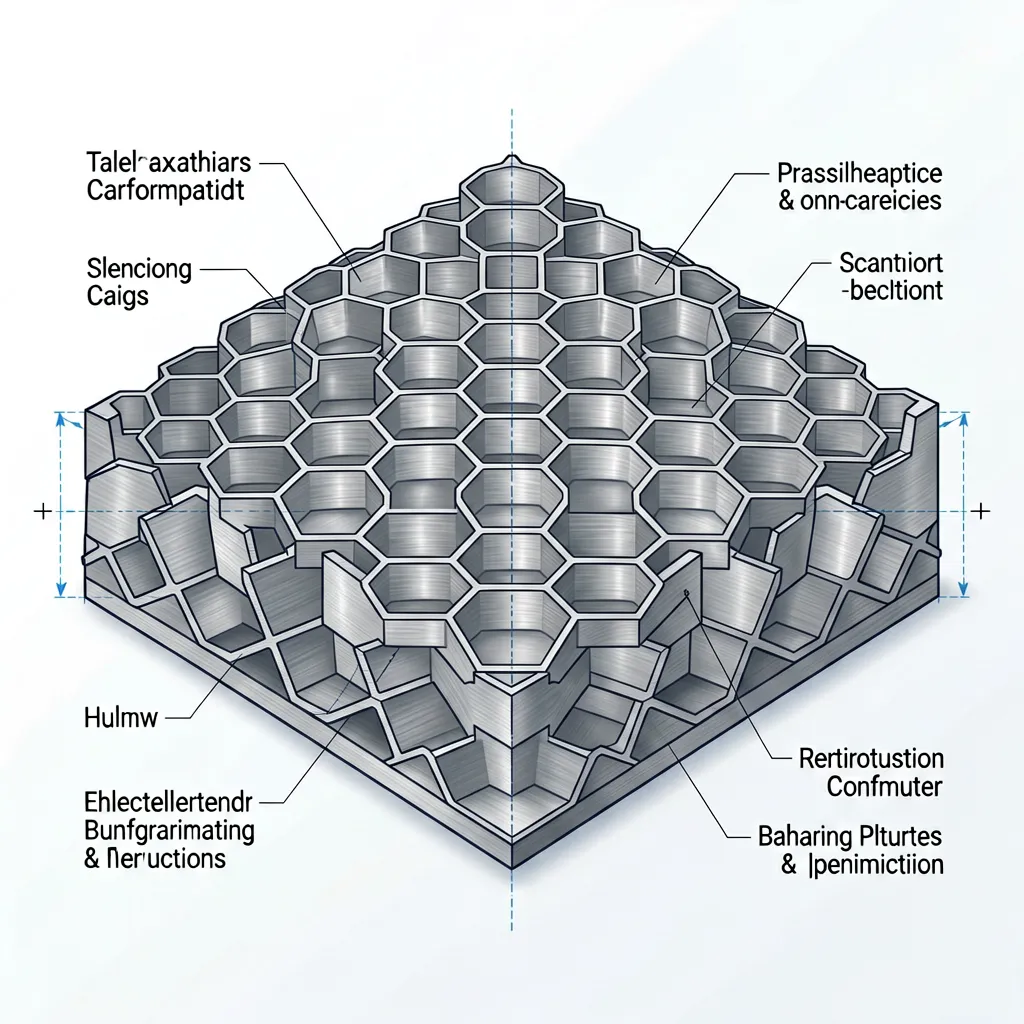
Aluminum honeycomb panel cross-section: hexagonal aluminum core bonded between two aluminum face sheets provides exceptional strength-to-weight ratio.
Aluminum Gauge
The thickness of the aluminum sheet (gauge) directly affects durability and cost:
- 0.6mm–0.8mm: Budget residential; suitable for low-impact use
- 0.8mm–1.0mm: Standard residential wholesale; most common in mid-range builds
- 1.0mm–1.5mm: Premium/commercial grade; recommended for rental properties and heavy-use environments
Finish Types
- Anodized: Electrochemically treated surface; highly scratch-resistant, available in multiple colors. Best for premium builds.
- Powder coating: Thermally applied polymer finish; excellent durability, wide color range, and compliance with AAMA 2604/2605 standards.
- Wood-grain transfer (PVC/veneer overlay): Aluminum panel with printed wood-grain film. Achieves wood aesthetics with aluminum performance.
- Brushed / Mirror: Decorative finishes for accent panels and visible surfaces; requires maintenance in high-touch areas.
Hardware
Demand these specifications from your Chinese supplier:
- Soft-close hinges: BLUM, Hettich, or equivalent branded hinges — not generic Chinese hinges
- Soft-close drawer slides: 45kg+ rated, full-extension, tandem or tandem-plus type
- Adjustable legs: Stainless or aluminum, minimum 100mm height adjustment
- Handles: Aluminum, stainless steel, or solid brass — specify finish and CC dimension (96mm, 128mm, or 160mm are standard)
How to Source Aluminum Kitchen Cabinets from China Manufacturers
Sourcing from Chinese manufacturers requires a structured approach. A disorganized process leads to quality surprises, missed deadlines, and costly reorders. Follow these steps to build a reliable aluminum kitchen cabinets wholesale supply relationship.
- Define your specifications precisely. Before contacting any supplier, document cabinet dimensions (height, width, depth), panel construction (honeycomb or hollow-core), gauge, finish type, hardware brand requirements, and any custom configurations. Chinese manufacturers work most efficiently with detailed technical packs (TPIs — Technical Product Information sheets).
- Verify the factory’s credentials. Request copies of ISO 9001 (quality management), ISO 14001 (environmental management), and CE marking certificates. For North American buyers, verify CARB Phase 2 compliance if any engineered wood components are used inside the cabinet.
- Request pre-production samples. Standard practice is to order 1–3 cabinet door samples and one base cabinet unit before confirming a bulk order. Expect to pay for samples; they are non-negotiable for serious buyers. A sample order typically costs $200–$600 depending on complexity.
- Understand minimum order quantities (MOQ). Most Chinese aluminum cabinet manufacturers set MOQs at 20–50 complete cabinet sets or one full 20-foot container equivalent. Some offer lower MOQs (5–10 sets) for standard sizes with no customization. Be explicit about your volume expectations from day one.
- Clarify payment terms. Industry standard for first orders is 30% deposit, 70% before shipment (or via irrevocable Letter of Credit). Be wary of suppliers demanding 100% upfront payment. Alibaba Trade Assurance, PayPal for small orders, and T/T bank transfers are common payment methods. Established manufacturers may offer net-30 terms for repeat buyers with established credit history.
- Confirm lead times in writing. Typical lead time for a full 40HQ container of aluminum cabinets is 30–45 days from deposit receipt and spec confirmation, plus 25–45 days for ocean freight to North American West Coast ports. Request a detailed production schedule with milestone checkpoints.
- Use third-party inspection (QC) services. For orders exceeding $10,000, hire a reputable inspection agency such as QIMA, Bureau Veritas, or SGS to conduct pre-shipment inspection (PSI). Typical cost: $250–$500 per day for a QC inspector. This is a mandatory expense for professional buyers.
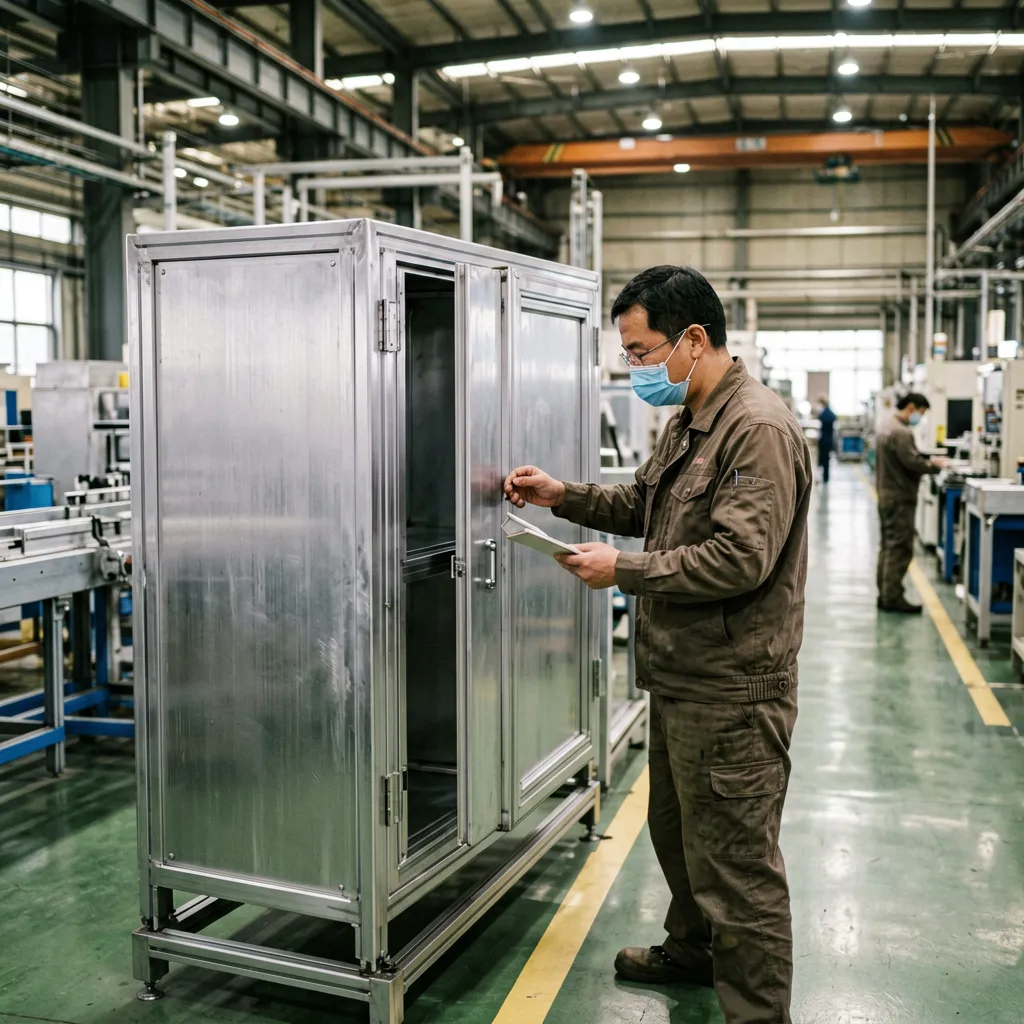
Third-party inspection at the factory floor ensures cabinet dimensions, finish quality, and hardware compliance match your specifications before loading.
Understanding Pricing: What Affects the Cost of Wholesale Aluminum Cabinets from China
Aluminum cabinet manufacturers price their products based on several variables. Understanding these drivers lets you optimize your spec sheet for your target price point without sacrificing quality where it matters.
Panel Type
Honeycomb panels command a 15–25% premium over hollow-core extruded panels due to superior rigidity and manufacturing complexity. For most residential wholesale orders, the cost difference is justified by reduced callback rates.
Dimensions and Configuration
Standard base cabinets (810mmH × 600mmD × various widths) and wall cabinets (720mmH × 300D) have the best pricing because they use production-line tooling. Custom dimensions, non-standard depths, or island configurations increase unit costs by 10–30%.
Finish and Color
Standard powder-coat colors (white, black, gray, beige) are included in base pricing. Custom RAL colors, wood-grain transfers, and multi-tone finishes add $5–$25 per linear meter depending on complexity.
Hardware Package
Generic Chinese hardware packages run $15–$25 per linear meter. Branded European hardware (BLUM soft-close hinges and slides) adds $40–$80 per linear meter but dramatically reduces field failure rates and callbacks.
Volume Discounts
Most manufacturers offer tiered pricing:
- 1–5 sets: Retail or near-retail pricing
- 5–20 sets: 10–15% discount from list price
- 20–100 sets: 15–25% discount
- 100+ sets (full container): 25–40% discount
Wholesale Price Benchmarks (2026 Estimates)
Based on market data from Alibaba Industrial and direct manufacturer quotes collected Q1–Q2 2026, expect the following wholesale price ranges for standard 18mm aluminum honeycomb cabinets with powder-coat finish and generic soft-close hardware:
- Base cabinets: $85–$160 per linear meter (FOB China)
- Wall cabinets: $55–$95 per linear meter (FOB China)
- Tall/utility cabinets: $120–$200 per linear meter (FOB China)
Add approximately $3,500–$6,500 for ocean freight (40HQ container) from major Chinese ports (Yiwu, Shanghai, Shenzhen) to Los Angeles/Long Beach, plus domestic freight to your warehouse.
Quality Standards and Certifications to Require from Chinese Suppliers
North American building codes and consumer expectations are among the world’s most stringent. Your aluminum cabinet supply agreement must include documentation of the following standards.
Structural and Performance Standards
- ASTM B209: Standard specification for aluminum and aluminum-alloy sheet and plate — confirms raw material quality
- ANSI/BHMA A156.9: American National Standard for cabinet hardware — relevant for hinges, slides, and catches if you specify North American hardware
- ISO 6892: Tensile testing for aluminum alloy panels — ensures structural integrity under load
Environmental and Health Standards
- CARB Phase 2 (EPA TSCA Title VI): Mandatory for any composite wood components. Limits formaldehyde emissions to 0.05 ppm (less than 0.09 mg/m³). Most reputable Chinese manufacturers hold CARB-certified panels from mills such as Greentech or Guangxi Fenglin.
- EPA TSCA Title VI compliance: Required for all composite wood imported into or sold in the United States (effective 2024).
- CE Marking: Required for products sold in the European Economic Area; some Chinese manufacturers carry it as a quality signal even for North American buyers.
Moisture and Corrosion Testing
Request certificates for the following tests conducted on your specific product:
- Salt spray test (ASTM B117): 1,000+ hours without white rust or pitting corrosion
- Humidity chamber test: 96 hours at 95% relative humidity with no delamination or corrosion
- Finish adhesion test (ASTM D3359): Tape-pull test rating of 4B or higher for powder-coat finishes
Factory Audit Standards
- ISO 9001:2015: Quality management system certification
- Sedex Members Ethical Trade Audit (SMETA): Social compliance audit preferred for buyers with ESG requirements
EPA Regulatory Note: Under the Toxic Substances Control Act (TSCA) Title VI, all composite wood components in cabinets imported into the United States must be CARB Phase 2 compliant. Ensure your Chinese supplier provides mill certificates and third-party test reports — do not accept self-declarations alone.
Source: United States Environmental Protection Agency. Formaldehyde Standards for Composite Wood Products. epa.gov/formaldehyde/formaldehyde-standards-composite-wood-products
Shipping and Logistics: Getting Your Aluminum Cabinets from China
Shipping heavy, volume-efficient cargo like aluminum cabinets from China requires understanding the key trade terms, container logistics, and lead time buffers.

Well-packed aluminum cabinet orders are loaded into 40HQ containers at major Chinese export ports. Proper crating prevents transit damage on the 15–30 day ocean crossing.
Incoterms You Need to Know
- FOB (Free on Board) — Chinese Port: The manufacturer delivers the cargo to the port of export. You pay freight and insurance from that point. The most common term for aluminum kitchen cabinets wholesale buyers from China. Your freight forwarder takes over once the cargo is loaded.
- CIF (Cost, Insurance, Freight) — Your Destination Port: The supplier arranges and pays for ocean freight and insurance to your port. You take delivery at the destination port. Slightly higher total cost but reduces your logistics management burden for first-time importers.
- DDP (Delivered Duty Paid): The supplier handles everything including customs clearance and delivery to your door. Convenient but less transparent on cost breakdown.
Container Planning
- 20GP container: Holds ~40–55 linear meters of cabinetry; suitable for small-to-medium projects
- 40GP container: Holds ~80–110 linear meters
- 40HQ container: Holds ~100–140 linear meters; the most common choice for wholesale orders
Lead Time Summary
- Sample production: 10–15 days after spec confirmation
- Bulk production: 30–45 days after sample approval and deposit
- Ocean freight (FCL): 20–35 days (West Coast); 35–50 days (East Coast via Panama Canal or transpacific to Gulf)
- Customs clearance: 2–5 business days (US Customs)
- Total door-to-door estimate: 65–90 days from deposit to warehouse receipt
Duty and Import Considerations
Aluminum cabinets typically fall under HTS code 9403.60.8080 (wooden furniture, other) or 9403.90.7000 depending on their primary structural material. Your customs broker will confirm the applicable rate. General wooden furniture enters the US at a base duty rate of 0% (MFN) under the Most Favored Nation tariff schedule, though this is subject to change based on ongoing trade policy. Always verify current rates with a licensed customs broker before importing.
Top 5 Reasons to Buy Aluminum Kitchen Cabinets from China in 2026
- Superior Moisture Performance Eliminates the #1 Kitchen Callback. Unlike wood, aluminum cabinets absorb zero moisture, eliminate swelling, warping, and mold risk, and carry a 40+ year service life. In coastal Florida, the Gulf Coast, the Pacific Northwest, and Hawaii, this durability translates directly to reduced warranty costs and stronger client relationships.
- Significant Cost Advantage Without Sacrificing Quality. Wholesale aluminum kitchen cabinets from China can cost 30–45% less than North American-manufactured equivalents with equivalent or superior moisture performance. For a 50-unit residential development, this can represent $15,000–$40,000 in savings on cabinet line items alone.
- Customization at a Scale That Domestic Suppliers Can’t Match. Chinese manufacturers routinely produce custom dimensions, proprietary finishes, and branded hardware packages for international buyers. If your project requires non-standard depths, integrated LED channels, or specific RAL color matching, Chinese suppliers can accommodate these without the 12–24 week lead times common among domestic custom cabinet shops.
- Green Building Compliance Is Built In. Aluminum cabinets from certified Chinese manufacturers produce zero formaldehyde emissions, are 100% recyclable, and meet CARB Phase 2 / EPA TSCA Title VI requirements. This positions your projects favorably for LEED, Energy Star, and NAHB Green Building certification — increasingly important selling points for developers targeting code-compliant or ESG-conscious buyers.
- Mature Logistics Networks Make Importing Straightforward. The China-to-North-America shipping lane is one of the world’s most efficient freight corridors. Established freight forwarders, consolidated container services, and experienced customs brokers mean that even first-time importers can move cargo reliably. With proper planning and a 3-month lead time buffer, the logistics are manageable for any professional buyer.
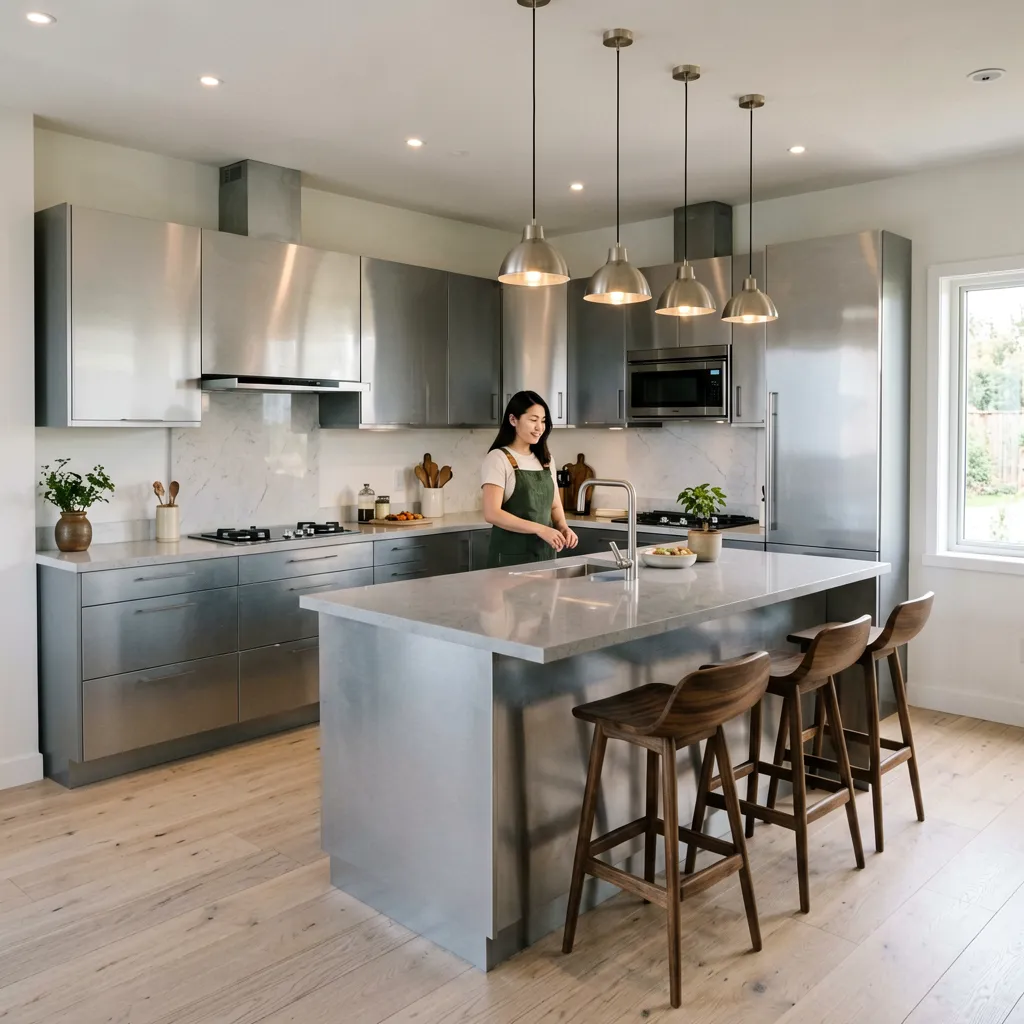
Aluminum kitchen cabinets adapt seamlessly to island configurations and open-plan layouts favored in contemporary residential design.
Sık Sorulan Sorular
Minimum order quantities vary by manufacturer, but most Chinese aluminum cabinet factories set their MOQ between 20 and 50 complete cabinet sets, or the equivalent of approximately one full 20-foot container. Some manufacturers offer reduced MOQs (5–10 sets) for standard, non-customized dimensions. For large-scale projects such as multi-family developments or commercial builds, a single 40HQ container (100+ linear meters) typically yields the best unit pricing and logistics efficiency.
Yes, absolutely. Aluminum kitchen cabinets meet or exceed North American residential performance expectations when properly specified. Key requirements to confirm with your supplier: CARB Phase 2 / EPA TSCA Title VI compliance for any composite wood components; soft-close European hardware (BLUM or equivalent); powder-coat finish meeting AAMA 2604 standards; and proper packaging for ocean freight. Finished aluminum cabinets in residential settings have a design life of 40+ years with minimal maintenance.
Plan for 65–90 days total from the date of your deposit and final specification confirmation to receiving goods at your North American warehouse. This includes: sample approval (10–15 days), bulk production (30–45 days), ocean freight to West Coast (20–35 days), and customs clearance (2–5 business days). East Coast delivery via the Panama Canal or around-South-America routes adds 15–20 additional days. Always build a 2–3 week buffer into your project schedule.
One of aluminum’s major advantages is its minimal maintenance requirement. For powder-coated finishes, clean periodically with a soft cloth and mild soap-and-water solution. Avoid abrasive cleaners, steel wool, and acidic substances (vinegar, citrus cleaners) which can damage the powder-coat surface. Check and tighten hinge hardware annually. Unlike wood cabinets, aluminum cabinets do not require resealing, refinishing, or repainting under normal residential use conditions.
Yes — and this is one of aluminum’s strongest use cases. Marine-grade aluminum cabinets are specifically engineered for outdoor exposure, poolside bars, yacht galleys, and covered outdoor kitchens. Confirm that your supplier specifies marine-grade aluminum alloy (typically 5052-H32 or 6061-T6), marine-grade hardware (316 stainless steel), and UV-resistant powder-coat finish rated for exterior exposure. Salt spray test results (ASTM B117, 1,000 hours minimum) should be requested and reviewed.
Industry standard for first orders is 30% deposit (T/T), 70% balance paid before shipment. Irrevocable Letter of Credit (L/C) is preferred for orders above $30,000 as it offers both parties payment protection. Established buyers with proven track records may negotiate 30/70 split with net-30 payment for the balance after delivery. Alibaba Trade Assurance is available for orders placed through the platform. Be cautious of suppliers requesting 100% prepayment — this is not standard practice with reputable manufacturers.
They can and should. Aluminum cabinet carcasses (the structural box) contain no wood and therefore emit no formaldehyde. However, most manufacturers use engineered wood (particleboard or MDF) for interior shelving, drawer bottoms, and certain structural panels. These components must be CARB Phase 2 / EPA TSCA Title VI compliant. Request mill certificates from your supplier confirming CARB compliance for all composite wood components. Third-party testing by recognized labs (SGS, Bureau Veritas, TÜV) is the gold standard for verification.
Honeycomb panels feature two aluminum face sheets bonded to a hexagonal aluminum honeycomb core. This construction provides superior flatness, rigidity, and impact resistance with significantly less weight. It is the preferred construction for high-end residential and commercial cabinets. Hollow-core extruded panels use aluminum frames with aluminum sheet skins, creating a tubular interior. They are lighter and less expensive but offer less rigidity across wide spans and reduced sound dampening. For wholesale buyers targeting premium or commercial markets, honeycomb panels are strongly recommended.
References & Sources
- Fortune Business Insights. (2025). Kitchen Cabinets Market Size, Share & COVID-19 Impact Analysis — Global Outlook 2025–2033. Retrieved from https://www.fortunebusinessinsights.com
- National Kitchen & Bath Association (NKBA). (2024). 2024 Design Trends Report. NKBA, Hackettstown, NJ. Retrieved from https://www.nkba.org
- U.S. Environmental Protection Agency (EPA). (2024). Formaldehyde Standards for Composite Wood Products — TSCA Title VI. Retrieved from https://www.epa.gov/formaldehyde/formaldehyde-standards-composite-wood-products
- ASTM International. (2022). ASTM B209 / B209M – 22: Standard Specification for Aluminum and Aluminum-Alloy Sheet and Plate. ASTM International, West Conshohocken, PA. DOI: 10.1520/B0209_B0209M-22
- ASTM International. (2022). ASTM B117 – 22: Standard Practice for Operating Salt Spray (Fog) Apparatus. ASTM International, West Conshohocken, PA. DOI: 10.1520/B0117-22
- American Architectural Manufacturers Association (AAMA). (2020). AAMA 2604-20: Voluntary Specification, Performance Requirements and Test Procedures for High Performance Organic Coatings on Aluminum Extrusions and Panels. AAMA, Schaumburg, IL.
- International Trade Administration (ITA), U.S. Department of Commerce. (2025). China – Country Commercial Guide: Construction Equipment and Materials. Retrieved from https://www.trade.gov
Ready to Source Aluminum Kitchen Cabinets?
FSHUO Building connects North American wholesale buyers with vetted Chinese manufacturers for premium aluminum kitchen cabinets. Whether you’re planning a single luxury home build or a 200-unit development, our team can help you source the right product at the right price.
Contact Our Trade Team